
Hardware Identification (HWID) Privacy Guide
Disclaimer: This guide is for privacy research, hardware fingerprint testing, and education. It is not for violating any Terms of Service. What this guide is: A deep, technical hardware privacy guide about spoofing/changing hardware identifiers to make a machine as unidentifiable and untraceable as possible under advanced fingerprinting.
Read it as a website: hwid.idkzal.ccNew here? Start with Getting Started: what an HWID is, the order of work, and how to check before and after. Anti-cheats: see the Reported anti-cheat status (evidence matrix: vendor statements, artifact-backed reports, and unverified claims, graded). HWIDChecker: a Windows app that lists the identifiers these guides change. Screenshots and download.
HWIDChecker
A Windows 10/11 app that lists the hardware identifiers these guides change, exports them, and compares a before and after export. Download HWIDChecker.exe and run it as administrator.
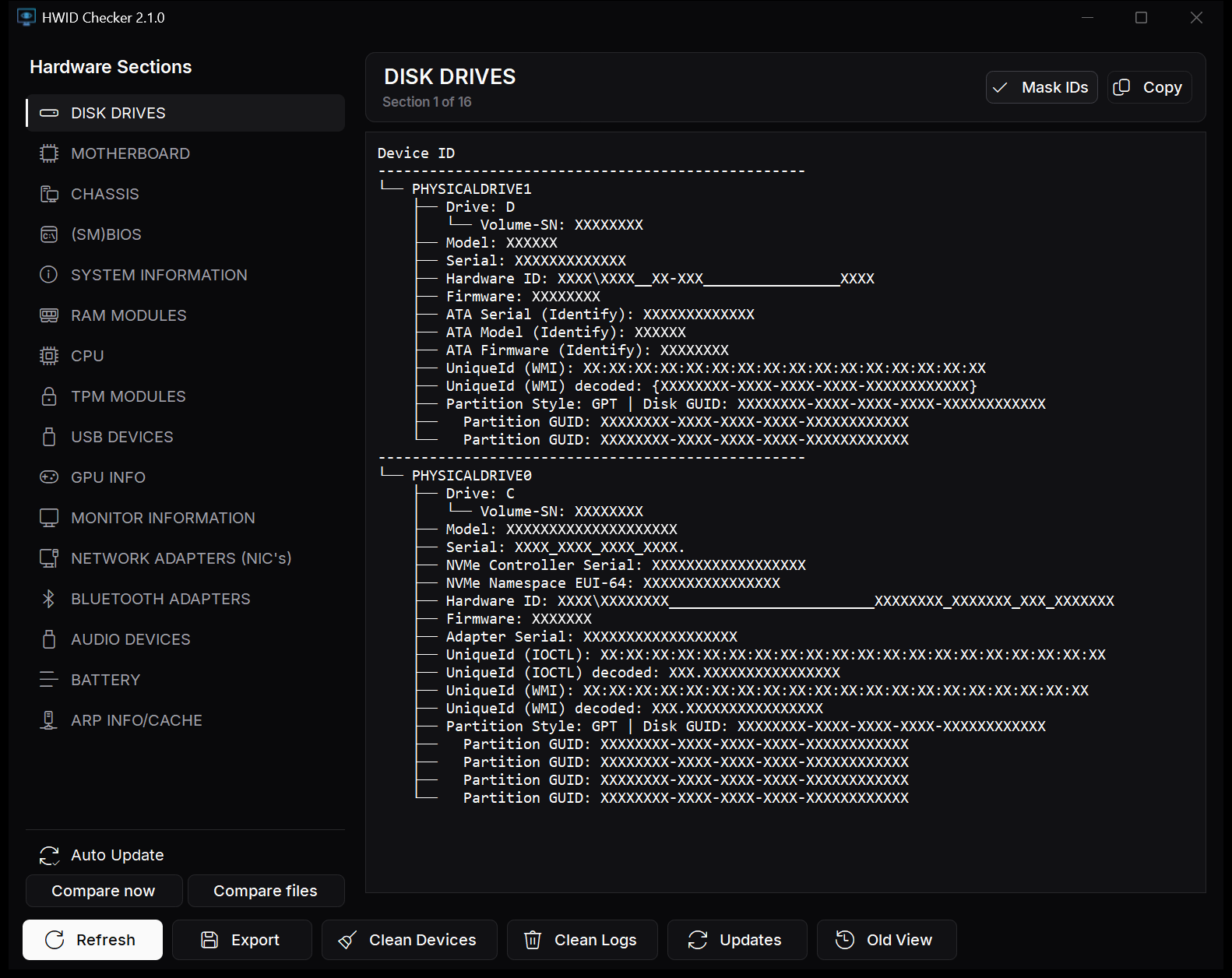
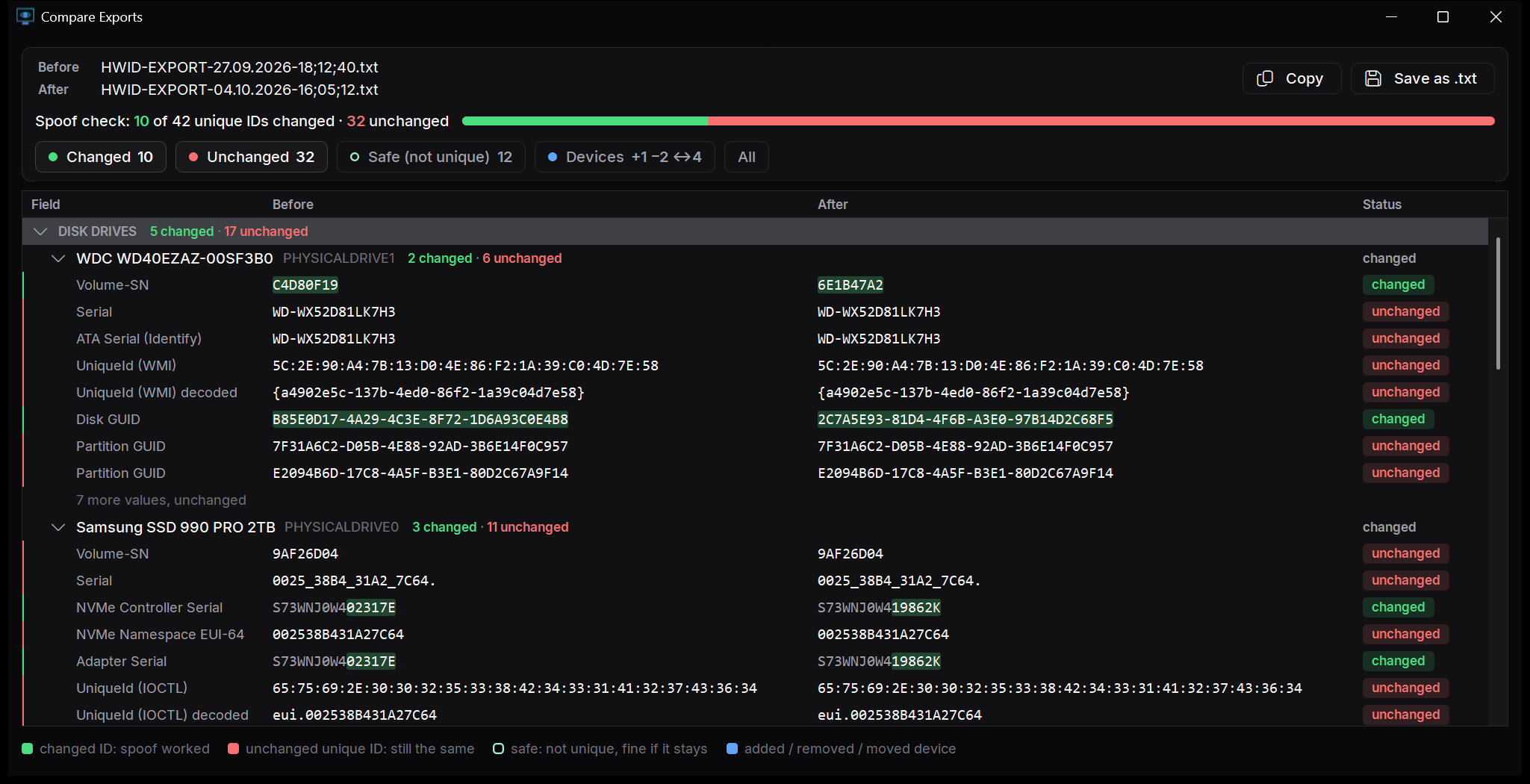
Table of Contents
- Hardware Identification (HWID) Privacy Guide
Hardware Categories & Evasion Strategies
1. Motherboard
Changes the SMBIOS serials and UUID that Windows, fingerprinting tools, and anti-cheats read from the board.
Serial Spoofing
- Complete Guide: Motherboard Spoofing Guide
- NVRAM / EFI variables: NVRAM Guide
- Key Points:
- Use DMIEdit (for AMI BIOS)
- Change only 2–5 digits of original serial
- Avoid odd patterns (e.g.,
SPOOFER-XXXX) - Reflash BIOS and clear CMOS after changes
RGB Control/USB Serials
- Intel: Disable USB ports used for RGB in BIOS (some boards provide per-port toggles).
- AMD (AM4/AM5): Unplug RGB headers or use boards with hardware toggles (e.g., ASUS ROG, MSI).
- Note: Some RGB controllers (e.g., MSI Mystic Light) expose distinct USB serials.
2. Storage
Rewrites the controller-reported model, serial, and firmware of supported SSDs. Volume serials and RAID identities are separate layers that do not prove the drive serial changed.
- Complete Guide: Storage Guide (identifier layers, controller check, USB enclosures, RAID vs volume serials)
NVMe SSDs (M.2)
- Controller: Maxio MAP1202 needed
- How-To:
SATA SSDs (2.5")
- Controller: YANSEN SSD needed
- How-To:
Modifying these drives can void warranties.
RAID behavior depends on the controller. The logical array identity, and whether member-drive serials pass through, depend on the exact controller, firmware, and driver. Neither hardware RAID nor software/BIOS RAID is established as an accepted identity-change method.
Older info (outdated)
Software/BIOS-based RAID0 is generally virtual and unsafe for HWID evasion.
Hardware RAID
- Why: A hardware RAID controller hides member-drive serials from the OS only if the controller and its driver do not pass them through. Whether a given anti-cheat still reads member serials through an array is reported both ways; the reports conflict and none includes a versioned test. Controller-level spoofing (above) changes the serial itself and does not depend on this. See Reported anti-cheat status and RAID, disk identity, and volume identity in the storage guide.
- Examples:
- S322M225R (for M.2 drives).
- LSI/MegaRAID models for SATA/SAS drives.
- Note: True hardware RAID tends to cost more. Whether it masks member-drive identifiers depends on the controller, its firmware, and its driver. Check pass-through on your exact controller before you rely on it.
Older info (outdated)
- Note: True hardware RAID tends to cost more, but it helps mask original drive identifiers on a lower level.
- Why: A proper hardware RAID controller prevents the OS (and fingerprinting agents) from querying individual drive serials.
3. Network Interface Card (NIC)
Changes the MAC address the network sees. A Windows NetworkAddress override is software-only; a controller write (EEPROM, NVM, OTP, or eFuse) is permanent.
MAC Address Spoofing
- Complete Guide: MAC Spoofing Guide
- Internal NICs: Permanent changes possible for Intel, Realtek, and Mellanox:
- Intel i225 from NVM 1.53 and all i226 versions lock the NVM after a unique MAC is provisioned and the card is power-cycled. Retail i226 is normally already provisioned once, so it is not repeatably rewritable. A (Intel Community)
- Intel NIC MAC Spoofing Guide
- Realtek NIC MAC Spoofing Guide
- Mellanox ConnectX-3 MAC Spoofing Guide - firmware-level, repeatable, 10 Gbps SFP+
- Note: Certain models might not support flashing or may revert.
- USB NICs: Both Realtek and ASIX adapters support MAC changes:
- Top recommendation: Realtek RTL8159 USB-C 10GbE, tested on the Lekuo DR59R11, with this project's rtl8159-flasher. One exe, no driver install, changes the stored MAC and the USB serial, often with a free way back. Verified on one unit, including a write by the app itself; only the two-step one-click change is not yet hardware-tested.
- Complete USB NIC Guide
- Recommended (2.5GbE, Realtek USB PG Tool): USB‑C 2.5GbE Adapter • Amazon DE
- Purchasable HWID Spoofers: Some handle NIC spoofing, but certain NICs resist it, and they can produce questionable serial data in other areas.
- Best Practice: Keep the first 6 digits (vendor ID), change only the last 6. For a self-chosen address, the IEEE-correct form is a locally administered unicast address (first octet with the local bit set, multicast bit clear, for example
02:); Windows, Android, and Apple all use this form for randomized Wi-Fi. A
4. GPU
No verified persistent-change method for current cards. Both vendors document a per-unit GPU ID. Which ID a program can read depends on the card, the driver, and the OS.
- NVIDIA: UUID accessible via
nvidia-smi.- No stable public spoofing guide is widely known. Advanced driver-level hooking may exist, but it's risky and can be flagged.
- NVIDIA defines the GPU UUID as globally unique and immutable. It also exposes a 64-bit per-device ID (PDI) and, on supported products, a board serial. A (nvidia-smi documentation)
- AMD: The Linux AMDGPU driver exposes a persistent
unique_idon supported GFX9+ GPUs. AMD SMI exposesamdsmi_get_gpu_device_uuid()and an ASIC serial, and ROCm SMI has--showuniqueid. Support depends on the device and platform; unsupported cards return N/A. A (AMDGPU docs, AMD SMI header)
Older info (outdated)
- AMD has no publicly documented UUID.
- NVIDIA GPU UUIDs are not always globally unique, but they can still be used for correlation.
- AMD: No publicly documented UUID. Generally seen as safer for HWID privacy.
5. RAM
RAM modules carry a serial in SPD storage. Modules that ship with null serials need no write; otherwise an external programmer can edit the SPD identity fields. A null serial is a real-world exception, not the JEDEC-compliant norm (unique serials required).
- Complete Guide: RAM Guide
- Null Serials:
- Corsair DDR4/DDR5
- GEIL DDR4/DDR5
- Trident Z G.Skill DDR4/DDR5
6. USB Peripherals
Keyboards, mice, and sticks expose USB serials that fingerprinting stacks can read directly from the protocol. Registry edits do not hide them.
- Keyboards/Mice: Serial behavior is per model and per connection mode, not per brand. Check the exact VID:PID.
- Razer DeathAdder V3 wired (
1532:00b2):SerialNumber=0, so no serial descriptor. One log. S (log) - Razer DeathAdder V3 Pro wired (
1532:00b7): serial string000000000000. The descriptor exists but is zero-filled and not unique. One log. S (log) - Razer HyperPolling receiver (
1532:00c3):SerialNumber=0. One log. S (OpenRazer issue) - The printed warranty serial on the product is a separate ID. It does not tell you whether a USB serial descriptor exists. A (Razer support)
- No current per-model evidence exists for ROCCAT, whose product lines moved to Turtle Beach, or for Xtrfy.
- Razer DeathAdder V3 wired (
- USB Sticks: Some “UDisk” drives default to
00000000. This is an unverified historical report. S- Verify with USBDeview.
- Avoid: Devices with hardcoded hardware serials you cannot edit.
- Don't trust software claiming to hide USB serials via registry edits. Windows
IgnoreHWSerNumonly changes how Windows builds the PnP instance ID. It does not change the device's descriptor serial, which a program can still request at the protocol level. A (Microsoft) - Any advanced fingerprinting stack can pull serials directly from the USB protocol. Registry changes do not hide that data. You can validate this yourself: hide USB devices in the registry, then inspect traffic with a USB debugger; the serials still appear.
- Don't trust software claiming to hide USB serials via registry edits. Windows
Older info (outdated)
- Roccat (now Turtleshell), Xtrfy models and "all" Razer products should not have USB serials.
- Don't trust software claiming to hide USB serials via registry edits; those methods are useless.
7. EDID / Monitor Spoofing
Changes the EDID identity (manufacturer, model, serial) a monitor reports to the system, through a software override, an inline emulator, or a firmware tool for a supported monitor.
- Complete Guide: Monitor / EDID Guide
- Why It Matters: Monitors contain EDID data with a potentially unique serial.
- Tools:
- Fuser or Dr.HDMI (4K version).
- EDID can be dumped, edited in a hex tool, and re-flashed via these devices.
- ASUS ROG Swift PG27AQDP (firmware MCM107): this project's pg27aqdp-serial tool changes the serial stored in the monitor through its own update interface, on HDMI and DisplayPort. No soldering, no emulator. Verified on the studied unit only.
- Result: The monitor appears as a different device, reducing traceability.
- Using a Fuser on 🍊 is not recommended, even with EDID spoofing.
8. Router (ARP Table Isolation)
Puts a router you control between the PC and the primary network, so the PC's ARP table shows the isolation router's MAC as gateway instead of your home router's.
- Complete Guide: Router / ARP Guide
- Hardware: GL.iNet running OpenWrt firmware or a custom-flashed OpenWrt router.
- Process:
- Change the router's MAC and hostname.
- Change the MAC of the port you're using on the router.
- (This is different from the router's main MAC!)
- Plug only your target test machine into the router's LAN port.
- Connect the router's WAN port to your home router.
- Keep other devices off the isolation router's LAN. The isolated ARP table still shows the gateway router, plus the normal Windows multicast entries below.
- And don't worry about those ARP addresses; they are normal and not unique. They're created by Windows:
224.0.0.22 01-00-5e-00-00-16 static224.0.0.236 01-00-5e-00-00-ec static224.0.0.251 01-00-5e-00-00-fb static224.0.0.252 01-00-5e-00-00-fc static192.168.8.255 ff-ff-ff-ff-ff-ff static239.255.255.250 01-00-5e-7f-ff-fa static255.255.255.255 ff-ff-ff-ff-ff-ff static
Older info (outdated)
- Avoid connecting other devices, so the ARP table shows only your target test machine.
9. TPM
The TPM carries its own endorsement identity (EK, EK certificate). Clearing the TPM does not replace it; see the TPM and fTPM reset guides for what does.
- Complete Guide: TPM Spoofing Guide
- fTPM identity reset (AMD AM5): fTPM Reset Guide
- Warning: dTPM support is product-specific. A faulty dTPM can fail attestation; FACEIT documents this and suggests fTPM as the fix. A Call of Duty's TPM requirements explicitly list systems with a discrete TPM chip as supported. A Blanket "dTPM is flagged" rules (e.g., 🍊) are community reports, not vendor statements. S
- Current Recommendation: Use fTPM for 🍊/🍒.
Older info (outdated)
- Warning: dTPM is flagged by some strict telemetry stacks (e.g., 🍊).
- Since 2025-04-04, 🍒 enforces fTPM if you’re flagged; dTPM no longer works there.
HWID Checker References
HWIDChecker is a standalone native Rust Windows 10/11 x64 app with 15 hardware sections. Download the executable below and run it as administrator. Screenshots: see HWIDChecker at the top. See the app readme for usage, build, and release commands.
- Download for Windows 10/11 x64: HWIDChecker.exe
- How to run, export, and compare before/after: Take before and after snapshots
Contribution & Updates
- Additional NIC spoofer models may be listed in the future.
- This guide evolves as new findings emerge.
Credits
Credits are a weird thing: not everything can be traced, and a lot of work/info in this guide came from many different places and people. I only list the people I know helped or are responsible for these sections in the first place.
- Storage guide/info: Priventive.de
- Network guide/info:
fA, and "the collective hive mind of the internet" - EDID guide/info:
fA(he did not invent the wheel, only gave me the info) - The broad base guide/structure was written by a "
French", Old Guide Link Fundryifor pasting/collecting this info and putting it out for everyone in one place (☭ ͜ʖ ☭)
meow
⠀⠀⠀⠀⠀⠀⣀⣀⣤⣤⣴⣦⣦⣀⣀⠀⠀⠀⠀⠀⠀⠀⠀⠀⠀⠀⠀⠀⠀⠀⠀⠀⠀⠀⠀⠀⠀⠀⠀⠀⠀⠀⠀⠀⠀⠀⠀⠀⠀⠀ ⠀⠀⠀⣠⣾⡿⠛⠛⡉⣉⣉⡀⠀⢤⡉⢳⣄⠀⠀⠀⠀⠀⠀⠀⠀⠀⠀⠀⠀⠀⠀⠀⠀⠀⠀⠀⠀⠀⠀⠀⠀⠀⠀⠀⠀⠀⠀⠀⠀⠀ ⣀⣤⣾⡿⢋⣴⣖⡟⠛⢻⣿⣿⣽⣆⠙⢦⡙⣧⡀⠀⠀⠀⠀⠀⠀⠀⠀⠀⠀⠀⠀⠀⠀⠀⠀⠀⠀⠀⠀⠀⢀⣠⠖⠒⠻⠻⠶⣦⣄⠀ ⠉⣿⢸⠁⣸⣥⣹⠧⡠⣾⣿⣿⣿⣿⣧⡈⢷⣼⣧⠀⠀⠀⠀⠀⠀⠀⠀⠀⠀⠀⠀⠀⠀⠀⠀⠀⠀⠀⠀⣠⣿⣾⣿⣿⣶⣦⣈⠈⠻⣤ ⠀⢹⡇⢸⣿⣿⣿⣿⣿⣿⣿⣿⣿⣿⣿⣿⠀⣿⣇⠀⠀⠀⠀⠀⠀⠀⠀⠀⠀⠀⠀⠀⠀⠀⠀⠀⠀⠀⢸⡟⣫⠀⠙⣿⣿⣿⣿⣷⡄⣽ ⠀⠀⠳⣾⣿⣿⣿⣿⣿⣿⣿⣿⣿⣿⣿⣟⣀⣿⣟⠀⠀⠀⠀⠀⠀⠀⠀⠀⠀⠀⠀⠀⠀⠀⠀⠀⠀⠀⠸⣷⣿⣿⣿⣿⣿⣿⣿⣿⣿⣿ ⠀⠀⠀⠀⠈⠙⠻⢿⣿⣿⣿⣿⣿⣿⣿⠭⠛⠉⠉⠀⠀⠀⠀⠀⠀⠀⠀⠀⠀⠀⠀⠀⠀⠀⠀⠀⠀⠀⠀⠸⣿⣿⣿⣿⣿⣿⣿⣿⣿⣿ ⠀⠀⠀⠀⠀⠀⠀⠀⠀⠀⠉⠉⠉⠉⠁⠀⠀⠀⠀⠀⠀⠀⠀⠀⠀⠀⠀⠀⡠⠒⡊⠙⠉⠉⠉⠓⠲⠤⡀⠀⠀⠙⠿⣿⣿⣿⣿⣿⣿⣿⠏ ⠀⠀⠀⠀⠀⠀⠀⠀⠀⠀⠀⠀⠀⠀⠀⠀⠀⠀⠀⠀⠀⠀⠀⠀⠀⠀⠐⠿⣦⣴⣿⣶⣶⠀⠠⠀⣰⣤⣿⣦⠀⠀⠀⠀⠉⠙⠛⠻⠛⠁⠀ ⠀⠀⠀⠀⠀⠀⠀⠀⠀⠀⠀⠀⠀⠀⠀⠀⠀⠀⠀⠀⠀⠀⠀⠀⠀⠀⠀⠀⠀⠀⠙⢛⠃⢀⣄⠀⣿⡿⠟⠉⠀⠀⠀⠀⠀⠀⠀⠀⠀⠀⠀ ⠀⠀⠀⠀⠀⠀⠀⠀⠀⠀⠀⠀⠀⠀⠀⠀⠀⠀⠀⠀⠀⠀⠀⠀⠀⠀⠀⠀⠀⠀⠀⠀⠀⠊⠟⠋⠈⠀⠀⠀⠀⠀⠀⠀⠀⠀⠀⠀⠀⠀⠀ ⠀⠀⠀⠀⠀⠀⠀⠀⠀⠀⠀⠀⠀⠀⠀⠀⠀⠀⠀⠀⠀⠀⠀⠀⠀⠀⠀⠀⠀⠀⠀⠀⠀⠀⠀⠀⠀⠀⠀⠀⠀⠀⠀⠀⠀⠀⠀⠀⠀⠀⠀ ⠀⠀⠀⠀⠀⠀⠀⠀⠀⠀⠀⠀⠀⠀⠀⠀⠀⠀⠀⠀⠀⠀⠀⠀⠀⠀⠀⠀⠀⠀⠀⠀⠀⠀⠀⠀⠀⠀⠀⠀⠀⠀⠀⠀⠀⠀⠀⠀⠀⠀⠀ ⠀⠀⠀⠀⠀⠀⠀⠀⠀⠀⠀⠀⠀⠀⠀⠀⠀⠀⠀⠀⠀⠀⠀⠀⠀⠀⠀⠀⠀⠀⠀⠀⠀⠀⠀⠀⠀⠀⠀⠀⠀⠀⠀⠀⠀⠀⠀⠀⠀⠀⠀ ⠀⠀⠀⠀⠀⠀⠀⠀⠀⠀⠀⠀⠀⠀⠀⠀⠀⠀⠀⠀⠀⠀⠀⠀⢦⣄⡀⠀⠀⢀⣀⣠⣴⡿⣿⣦⣀⠀⠀⠀⠀⢀⣴⠏⠀⠀⠀⠀⠀⠀⠀ ⠀⠀⠀⠀⠀⠀⠀⠀⠀⠀⠀⠀⠀⠀⠀⠀⠀⠀⠀⠀⠀⠀⠀⠀⠀⠙⠛⠻⠿⠉⠉⠉⠉⠉⠑⠋⠙⠻⡢⢖⡯⠉⠀⠀⠀⠀⠀